Archives for category: Uncategorized

Stargate

Image courtesy of Idea go, / FreeDigitalPhotos.net

Yesterday, I listened once again to a song I used to love back in the day. I would have never guessed there would be a time in the distant future I would be turning to Led Zeppelin for spiritual inspiration. Perhaps there truly has been a paradigm shift in my perspective, because, when I listened closely yesterday to the lyrics of this song I heard a strong spiritual message. The lyrics can be found at  LED ZEPPELIN – STAIRWAY TO HEAVEN LYRICS; reading them should help all of this make a bit more sense.

To  me, the lyrics tell a spiritual tale about a lady trying to buy her way into heaven by following the “rules” and with “good acts.”  The lyrics further imply that anxiously searching for the right way to enter heaven is a waste of time—that the “answer” for how to “get into heaven” is in the wind, and if we patiently wait in silence we will hear the “tune” that connects us all with each other and with God.  We will realize what we were searching for has been with us  and within us all along—that we are all one with God.

I never heard that message from Zeppelin before, and I may never do so again. My current perception of these lyrics resonates with my own spiritual journey. When I grew up in the Methodist church, it was very important to me to “do the right thing” in order to earn God’s favor and everyone else’s. I had a strong faith when I entered college. Then I learned to question everything, and, after a while, drugs and alcohol put a psychedelic spin on my perception of music…..hence, the term “tripping on the stairway” (in the psychedelic sense).

After graduating, working for several years, and getting sober and clean, I began to search for “the true meaning of life”—I studied numerous religions, I visited a variety of churches, I explored how various Native American cultures viewed Creator, etc. It took me a long time to find my way back to God, and now my perception and faith keep evolving. My involvement in contemplative prayer has deepened my conceptualization of God as being “with and within” each human being. It has strengthened my conviction of the importance of sharing “God with and within” with others….something I never would have done before. I don’t mean doing so by preaching or trying to “convert” someone to believing the way I do.  Instead, for me, the best way I can share my belief is to be my belief, to be a reflection of God’s love in my interaction with others. My job is to release God’s love so that others can “hear the tune.”

Please comment; I would love to hear/read your thoughts regarding “God With and God Within.” God bless and keep you.


new life

Image courtesy of mrpuen / FreeDigitalPhotos.net

In Alcoholics Anonymous, (2001,4th edition, p. 63), there is a paragraph that introduces what those in AA call the “Third Step Prayer.” Among other things it asks God to remove difficulties—-not for those praying but so that others can witness God’s power, love, and way of life. It concludes with a request to be able to always do God’s will. I have had many personal and professional opportunities through the years to ponder this prayer and to begin to understand the wisdom it contains.

Recently, I have begun to view it as a tool for  “detachment from self” that shifts my perspective from personal need to that of sharing, by attraction rather than promotion, God’s way of life. I have been asking God all my life to help me through my difficulties—but doing so for the benefit of others rather than myself has created a paradigm shift to a totally new perspective.

Those in AA talk about “doing the next right thing.” Some religious groups use the phrase “What would Jesus do?” Using the lens of surviving difficulties so that you can be a living illustration of God’s way of life goes a bit further for me. When I sincerely pray to be a channel for God’s love and wisdom and to be of service to him, the result happens almost without effort.. I find myself doing things I would have never dreamed possible before—-and if doubt starts to creep in, I remind myself I am only a channel and it is all about God rather than myself. The key for me in living this “effortless change” is  changing the focus of my attitude from self to God.

One example of how this has worked in my life occurs on a regular basis in the particular church I attend. I  sometimes have the privilege of reading from the old testament and the epistles to the congregation. I have a tendency to worry about reading  perfectly. When that worry is paramount,  I know I am focused on self rather than God. This reminder that it is “not about me” quickly erases the self-centered worry and concerns.

Another example is writing this blog every day. In the past, I have always written articles in professional journals, and writing that way was both a challenge and a job, something I had to do to be promoted. Such writing was difficult because it was focused on me and self-gain—and I felt strongly pressured to produce “perfect writing” because that was usually one of the main keys to getting published in professional journals. As a result of asking several times a day to be blessed to God’s service, this blog has emerged. I won’t say writing it is effortless, but it does feel God inspired.  I find myself looking forward every day to writing it because I never know which way God is going to send me, what I can learn that will guide my spiritual journey, or what God wants me to communicate to others….in other words, what used to be a job is now an adventure I get to look forward to on a daily basis.

Please comment on today’s topic of “effortless change”. I am very much interested in hearing how this concept influences your life. May God bless and keep you.

mirror reflection

Image courtesy of Stuart Miles / FreeDigitalPhotos.net

In one of my meditative readings today, I read a suggestion that we strive to mirror God’s spirit, truth, compassion, and love. I wish I could say my thoughts and actions always reflect those attributes, but, of course, I cannot. Then I thought of the fairy tale “Snow White” and the magic mirror constantly being asked by the queen “who was the fairest in all the land.” God sent me that image to remind me that it’s not “all about me” ——that I should not focus on myself but rather on what I “radiate” to others. He doesn’t want me to look in the mirror and see an aging, tired, “Sam’s Club Sized Person.” He wants me to see a person smiling and happy from the inside out—-someone whose appearance communicates love and compassion rather than self-centered vanity or self-depreciation. If I can reflect genuine (not superficial) aspects of God’s spirit, then I  can manifest God’s love and share it with my human brothers and sisters.

If I reflect God’s spirit, then my immediate reactions to ordinary day-by-day experiences should be loving and compassionate—–not angry and judgmental. To clarify, I’ve made a brief table to illustrate both God-reflective and self-centered responses to three situations I have experienced:

Situation Self-Centered Response God-Reflective Response
Car cuts me off in traffic I get angry, curse, tell them how to drive I think to myself they must have a lot on their mind, I hope they make it safely through the day
When I’m shopping, a nearby child whines, talks disrespectfully to his grandmother, is manipulative, is loud and demanding—this goes on for about 10 minutes. My immediate thought is how I’d like to grab the child, get in his face, and tell him how he should be behaving—or worse, spank him and send him out of the store to fend for himself. When the argument has finished, I smile and tell the grandmother she has a very persistent child. She tells me it runs in the family. And, indeed, her persistence lasted longer than her grandchild’s did.
My dog goes berserk running through the house, bullying one of my other dogs, clawing at my sofa like he is trying to dig to China. I yell at him to stop and threaten him with “going to the pound.” I realize he is “jealous” because I am paying attention to my computer instead of him. I hold him tight when he jumps into my lap, pet him and talk soothingly to him until he quiets down .

In reality, my initial “thought” response to all three of these situations was “self-centered”—-but at least for the last two, I redirected my response to the one that more closely mirror’s God’s spirit, truth, compassion, and love. Granted, I may have a spoiled dog that needs me to reflect God’s spirit of “tough-love” a bit more, but I just wanted to show you how I have to work at mirroring God’s perspective. I am making progress in my actions, but I still need to work on my initial “thought response.”

AA’s “Big Book” talks about the importance of honesty, openness, willingness, and taking action based on a strong-spiritual foundation. I believe the progress I make in reflecting  these AA principles in my life, the more progress I will make in reflecting God’s spirit, truth, compassion, and love.

How does the concept of mirroring fit into your life? What values do your thoughts and actions reflect?

Please comment as I look forward to reading your thoughts and comments on this topic. God bless and keep you.

Maggie Smith Photo

Image courtesy of Maggie Smith / FreeDigitalPhotos.net

There is a lyric that sometimes stubbornly bounces around my head thanks to Jimmy Buffet: “Wasting away again in Margaritaville.” Sometimes the lyric triggers nostalgia and a wish to return to simpler days when relaxing with a drink was still fun. But mostly, these days, it reminds me that each day is a special gift and I need to be careful not to get lost in mundane “activities of daily living” to the point that I forget to appreciate the gift. A friend of mine reminded me of this as we left a meeting this week. We were complaining about our aches and pains, and I remarked I didn’t like getting old at all. He replied to me, “It’s better than the alternative.” Of course, I’ve heard and said that before, but this time it hit home.

In Day By Day (Anonymous, 1974, on the page for September 23), the following meditation is printed:

“It is so easy for us to fall into a pattern of self-pity that we sometimes waste the best parts of our lives. The waste of life lies in the love we have not given, the experiences we have not used, the selfishness that will risk nothing, and the fear that blocks us from other people.”

This quote points me in the right direction whenever I am get bogged down in self-pity or worry about something I cannot control. This morning (and last night) I wasted my life by worrying about a fire in Huerfano County, Colorado, close to where my mobile home and acreage are located. I worried about the family that manages the property for me, I worried about the people that rent from me, I worried about losing the mobile home itself, I worried about the beautiful country in the high desert that was burning, I worried about the trees that would take decades to grow back, I worried about the wild life that lives in the high desert…..my list could go on and on. Fortunately, I had enough “recovery sense” to take a deep breath, to ask God to handle it, and to say a special prayer for everyone to be able to get to safety.

Reading the above “Day By Day” quote also reminds me of the 2007 film, “The Bucket List, ” a movie that emphasized the importance of seeking “experiences we have not used” when we realize our own death is  inevitable. It is, I think, equally important, if not more important, to go beyond seeking experiences——to give all the love we can, to work at overcoming our fears., and to fight our tendency to isolate from others. To apply this to myself, I need to love more, fear less, and risk more as I interact in relationship with others…..these are the gifts of life that are most precious because these are the gifts that connect me to God and to God manifested in self and others.

Your thoughts and comments are welcomed. May God bless and keep you.

rakratchada torsap Free Digital Photos

Image courtesy of rakratchada torsap, / FreeDigitalPhotos.net

Often, people in recovery can be heard proclaiming, “If you don’t give it away you’ll lose it!” When I first heard this it sounded so paradoxical to me  I had trouble understanding what they were really trying to communicate. Now, after thirty two years of being exposed to this philosophy, I, myself, have been heard to say the same thing numerous times because my experience has taught me what it means in terms of recovery. If I want to stay in recovery and free from the bondage of my addictions, I have to share the spiritual, life-saving message embodied in A.A.’s 12 step program. If I don’t,  I will slip out of recovery back into any or all of numerous addictions available to me. It’s kind of like “pay it forward, ” but it is more than that because this philosophy realizes  it is in giving that we receive. I think this quote from Keating may help my readers understand what “give it away or lose it” means to me:

“The best way to receive divine love is to give it away, and the more we pass on, the more we increase our capacity to receive.”

T. Keating, 2008,   Heart of the World, p. 15

As you can see by the above quote, I think my spiritual journey is based on sharing and receiving God’s love. This spiritual foundation works not only for nurturing my recovery and that of others but also in all aspects of my life. I am not claiming to have perfected living by this philosophy. I have to work at it one day at a time, and some days I am better at it than others. Thankfully, I know  what matters is the journey—- my willingness to try to the best of my ability. It is immensely relieving to realize I don’t have to be perfect. I must also continuously remind myself the minute I start feeling prideful about any accomplishment—-even being loved and being loving—- I begin losing my “spiritual balance” and start slipping back into the “bondage of self.”

Please comment and share your thoughts. God bless and keep you.

rim-bryce-canyon

bryce-canyon.jpg-royalty-free-stock-photograph.html” title=”Rim bryce canyon”>Rim bryce canyon by Jon Sullivan


Today’s topic is based on a quote from Thomas Keating (Keating, T. Open Mind, Open Heart: The Contemplative Dimension of the Gospel, p. 76):

“The reason any expectation is a hindrance is that it is a form of clinging, hence a desire to control.”

When I was a senior in high school, I was the one who came up with the idea  accepted for our graduating class motto: “Achievement is our goal.” I think we were reading “Great Expectations” in our literature class that year, so it only seemed natural for us to adopt this as an expectation. After all, we were young and the world was yet to be explored and conquered.

I grew up  in a world of fairy tales as told by Hans Christian Anderson, the Brothers Grimm and Walt Disney. I fully expected to find my prince charming and to live happily ever after. I accepted (and even sought?) the specific frog I would need to kiss. Good thing I was not expecting warts. I expected everyone to be honest, and everything to be fair. I left home, went to college, and became a “flower child”—–I bought into the expectation that the “system” was wrong and we could fix it.

Retrospectively, I was terribly naive. I  have traveled through  many experiences that taught me I cannot control or change anything other than myself. I can plant seeds—-ideas, suggestions, role modeling, etc.—– and sometimes they come into fruition, and sometimes they don’t. Often, the credit for them falls elsewhere. I have learned that I don’t have to be recognized as the initiator of an idea for it to become what it is supposed  to be.

I chose Keating’s quote because yesterday in a book study session focused on Richard Rhor’s “The Naked Now: Learning to See as the Mystics See ” (2009) we discussed his suggestions that:

  • God dwells within all of us whether we are aware of it or not
  • We all share the gift of grace and mercy, and nothing can be done to earn it
  • “God is both abyss and ground….the Presence that, paradoxically, always fills the abyss and shakes the ground” (p. 22)

By now, you are probably asking yourself what does any of this have to do with great expectations. I can only tell you what it  means for my spiritual journey. When I stubbornly hold onto my expectations of what things should be like I set myself up for repeated frustration, disappointment, and pain  because it is a fallacy to believe I can control anything other than my own attitudes and responses to reality. Clinging to these expectations is based on my  need to control everything so I can feel safe and secure. The very act of pursuing security this way creates more anxiety, fear, guilt, and anger…..and acts as a barrier keeping me  from letting go, “falling into the abyss” and being caught on the safe ground of God’s love that has been within me all along.

Am I “cling free, peaceful and serene” all  the time now because I have released my expectations to God? No. Each day I am able to let go of a little bit more and to feel a little bit more secure in God’s love. The result is a growing sense of relief and joy as I enter into building relationship with the God  within me and all that is around me.

Please share your thoughts and comments. God bless and keep you.

clock-electronic_w725_h544

My spiritual growth has brought me to a new perception of time as well as a new way of looking at change. At the beginning of my spiritual journey, I thought time was something on the face of a clock and something that was  described and predicted in various books.  I vigorously hung on to my perception of the world and the people who populated it (including myself)  as being things I could change, and I felt guilty and inadequate when I could not live up to this self-expectation.

Time

For years I have tried to reconcile my own spiritual beliefs with a concrete, commonly accepted perception of time. I have come to believe that God does not perceive time the way mankind does. This morning I found an excellent explanation of the way I believe God perceives  time:  According to Dr. Paul O. (1995, There’s More to Quitting Drinking than Quitting Drinking): “There is no past or future in Gods world, only this present moment. Time is an invention of man in his attempt to make sense of the Big Picture. God knows only the eternal Now….When we mind-trip into the past or into the future, we travel alone. God stays in reality, in the Now (O., 1995, There’s More to Quitting Drinking than Quitting Drinking, p. 159).”

The same author goes on to explain, “Nothing is unforeseen by God. Not because He has predetermined it (God is more all-knowing than all-controlling), but because He has always known that everything would be precisely the way it is right now. Every pebble, every blade of grass is where it has been known through all eternity that it would be at this precise moment” (p. 159). This rather profound proclamation can be more easily understood if God is perceived as always being in the reality of now with no context of past and future.

So, if I am living in the reality of “now,” then I need to live life on life’s terms. I need to stop being motivated by the need for approval and childish, stubbornly held onto beliefs that I can fix everything, everything has to be fair, and everybody will be honest.

Change

When something upsets me emotionally, I often want to analyze it to death so I can attribute cause/blame in order to “fix” the something. I have since learned that I always need to consider my attitude in regards to whatever is bothering me and,  almost always, the only thing I can realistically change in the “reality of the now” is my myself (my attitudes). Furthermore, my attitude most often needs to be changed to one of acceptance.

In reference to time and change, then, does this mean I am only responsible for being and nothing else? Well, the answer for me is both “yes” and “no.”  Yes, because I need to focus my mind  and spirit on being fully present in the here and how—-not in  the here and now I would like it to be, the here and now I have worried about,  or a here and now I have experienced in the past. No, because I need to realize problems in the “now” are best approached by examining how my own attitudes are influencing the situation. I am responsible in the eternal “now” to  accept reality as it is, and if guided by my Higher Power to change something, it is most often my own attitudes that need changed.

Please share your thoughts and comments on this topic. May God  bless and keep you.

Thunderstorm

Image courtesy of worradmu / FreeDigitalPhotos.net

That Yucky Color of Green

I am sitting here trying to think of something even slightly profound to say as the sky outside turns dark. It is taking on tinges of that “yucky color of green” that usually indicate a bad storm and/or tornado is in the making. Of course, my perception may be colored by my weather radio’s announcement that we are under a tornado watch. I am immediately reminded of the bible story about terrified disciples being out in a boat on a very stormy sea in real danger of drowning….when Jesus starts walking towards them on top of the water and says, “I am here, don’t be afraid.”

Some of my life experiences have been difficult ones in which I felt terrified and alone until I sought my Higher Power’s guidance and comfort. All I have ever needed to have was willingness to ask for help and the faith to accept it and act on it. Granted, the help and God’s solution were not always what I had in mind, but retrospectively speaking, my Higher Power’s plan for me  eventually led me through those storms and on to better things.

Alcoholics Anonymous’ Big Book tells us that those who seek a path of recovery are  well acquainted with fear because it was a common theme in their existence, and, as such, contributed greatly to their destructive drinking. The writers of the book suggest that one of the contributing factors to an alcoholic’s fear is discovering that self-reliance by itself is not sufficient for solving all of life’s problems.

One of my favorite paragraphs in the Big Book makes “I am here, don’t be afraid” come to life for me every time I read it. Here is what it says (p.68): “…For we are now on a different basis; the basis of trusting and relying upon God. We trust infinite God rather than our finite selves. We are in the world to play the role He assigns. Just to the extent that we do as we think He would have us, and humbly rely on Him, does He enable us to  match calamity with serenity.”

Many of us are like the disciples in the boat—-we are tossed about on the stormy sea of our fearful existence and almost drowned because our failing self-reliance repeatedly puts us in harm’s way. You see, the disciples got tired of waiting on Jesus to finish talking to a crowd of people, and they left without him. That is how they ended up in the boat without Jesus in the first place. Consequently, they were left relying on themselves to steer and man the boat, and the storm they encountered was more than they could handle. Like the disciples, if we are able to escape the trap of self-reliance——to have faith, to be willing to seek God’s help, to accept God’s help, and to follow God’s directions—– then our sea of calamity will become a sea of serenity.

Well, just in the time it took to type this, that “yucky color of green” is gone. Imagine that! 🙂

Please comment. God bless and keep you.

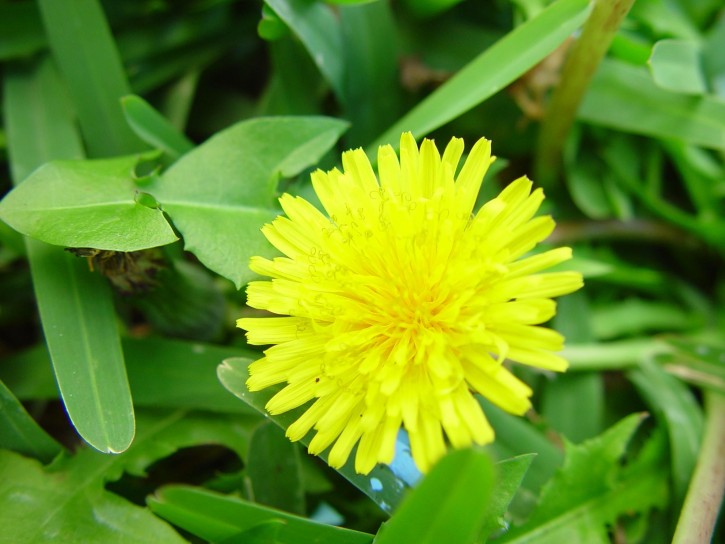
dandelion

http://www.copyright-free-images.com/flora-plants-copyright-free-images/flowers-copyright-free-images/dandelion-flowers-free-images/dandelion-flowering.jpg.html&#8221; title=”Dandelion flowering”>Dandelion flowering</a> by Leon Brooks

I have heard the topic of “dandelions” discussed in two ways by people in recovery. Both ways are supportive of recovery.

The first focuses on using dandelions as a metaphor for redirecting our thoughts from a negative to a positive perspective. The person talking about dandelions this way introduced the topic by saying how everyone abhors dandelions because they are such a persistent, hardy weed. That person then asked those of us who were listening if we’d ever considered dandelions as actually pretty little yellow flowers, quite like miniature mums…..then they could be perceived as pretty rather than bothersome.  The person went on to point out if we tried to see the positive  in whatever it is we view as a problem it becomes easier to handle and less likely to be something that can trigger relapse.

The second discussion I heard about dandelions in recovery “sprouted forth” during a discussion of what people in recovery call “character defects. ” Character defects are persistent, personal and problematic traits that are commonly accepted as being the underlying cause of many of the problems that lead to addictive behaviors. The person speaking said there were basically two ways to handle dandelions (character defects):  You can get rid of the flower by plucking it off from the top of the dandelion’s stem. The speaker equated this with a superficial attempt to “get rid of character defects” by only attacking the obvious, outward result of the underlying problem. Or you can try to get serious about removing the character defect and dig deep to find the underlying cause and remove it by “tearing the dandelion/character defect out by its roots”. When the later approach is used, the removal of the character defect is more effective and long lasting.

Now, how does this apply to spirituality? For me, it means I need to ask myself if I am creating weeds or flowers in my spiritual garden with the habitual way I think. My thoughts do, essentially, create my reality, and, if I am only seeing negative things, then my reality is negative. My life—-spiritual and otherwise—can be much more pleasant if I cultivate dandelion flowers and view things from a positive perspective. Don’t get me wrong. There are negative things, evil things in our world. And those things cannot be viewed as “flowers”—-but, with luck and prayer they can be avoided. When they cannot be avoided we can use the “negative experience” to teach us a “life lesson” that allows us to use what we experienced to give us compassion for others who have problems and to even “show us the way” to effectively help each other.

The other way of viewing dandelions is hard for me, spiritually speaking. I have never been a gardener. When I was a child, my job was to pick rocks out of the garden every day, and every day there were always more rocks to remove. Somehow, that just was not fun and did not leave me feeling like I had helped create anything—-other than just a nice smooth bed for new rocks. So, when it comes to dealing with dandelion/character defects, the path of least resistance for me is just to pluck the top of the “nuisance” off so I’ll look “fixed” to others and not have to feel the pain of digging deeper. Thus, my dandelions usually grow back as either the same character defects or other closely-related ones. Therefore, I am always finding new dandelions/character defects to work on and, hopefully, making spiritual progress even though I will never have a perfect “spiritual garden.” That’s okay, I am enjoying the journey—-and each time I try to remove a dandelion, I am able to remove just a bit more of it. I have even removed some roots and all, but it has taken a lot of growth, hard work, and prayer. And I am grateful the master gardener was there to help me!

I’d love to hear your comments about today’s topic. Please share your thoughts. God bless and keep you.

bread

Image courtesy of dan/ FreeDigitalPhotos.net

I know this seems like a strange topic, but today I want to reflect on the topic of “bread” as I think it relates to recovery and spirituality. In this region almost all twelve step meetings are closed with those present standing in a circle, holding hands and reciting the Lord’s Prayer. Part of that prayer, the one Christ taught as the way we should pray, asks God to “give us today our daily bread.”

For years, I very concretely assumed this phrase was asking God not to let us go hungry. In truth, it does probably ask that. However,  I think  it is asking more than that. In John 4, Christ associates “food” with doing God’s will, and that connotation applies more directly to spirituality and recovery. In fact, it is at the heart of recovery.  Asking God to allow us to do God’s will on a daily basis is a daily reminder to turn our will and our lives over to the God of our understanding.

Part of my recovery is refraining from drinking alcoholic beverages and eating anything with flour or sugar in it. Reminding myself of this “God’s will” meaning of food effectively redirects my thinking to that which is essential for my physical and spiritual well being whenever I am tempted to give into a craving.

Well, today’s topic was rather short, but I know, at least for me, it was important to clarify the spiritual and recovery-related meaning of something I have asked God for since I was a child. Comments and thoughts on this topic are welcome. God bless and keep you.