securedownloadcoin


Photo courtesy of K. Farwell

I awoke this morning from a very insightful dream.  In this dream I was once again married and being ignored by my husband. As in life, he was very self-absorbed. However, in my dream he had asked me if I “minded” something. I started to answer with a truly co-dependent response, “only about what it might do to you.” I caught myself mid-sentence in this scene and instead had the courage to tell him what I really thought without holding back so he “wouldn’t get upset.”  Of course, in this dream scene as I was talking my husband stomped off totally ignoring my answer to his question. In the dream I got angry enough to follow him around as he tried to evade me and  forcibly communicated my feelings and thoughts. Not surprisingly, they poured out of me——a veritable flood of emotions centered on abandonment issues and my anger and hurt over always be ignored.

You see, my life used to be like that. And this dream showed me, after all these years, the part I played in contributing to the sad state of affairs our marriage was in. I grew up in a family that taught me at an early age not to communicate feelings and to expect those around me to intuitively know what I wanted without me having to tell them because it was wrong to “want anything for yourself.”  This was the perfect upbringing to create a nurse who married a Viet Nam veteran with PTSD, depression, and a vast array of other “take care of me” issues.  I thought I was careful to avoid the role of care taker, but indirectly, and some times directly, I did so any way. I bought property in the middle of of the woods—-a cottage that was secluded and would feel more safe to him than a home in town would.

I started a pattern of living my life centered around meeting his emotional needs and neglecting my own. I got to the place where I wasn’t even able to acknowledge what I was feeling—-denial worked. I learned early into our marriage that I had to walk on egg shells and that the slightest comment or action that insinuated challenging what he said or wanted could trigger his anger. I was very afraid of his temper although he never struck me.

I am ashamed it has taken almost a decade for me to realize, thanks to this dream, that in never telling him what I was feeling or what I wanted I was setting myself up to be a doormat.  I did tell him sometimes, and fights usually resulted.  My childhood taught behavior of silent martyrdom was further reinforced. I have to take responsibility for contributing to and maintaining the dysfunctional communication patterns in our marriage.  Before this morning, I tended to blame him for all the problems we had, but now I can see I set the stage for what happened, and then I played my part well.

Where was God in all this? Definitely not at the center of my heart and being as He currently is but, instead, more on the “fringes of my soul” where I went to pray  automatically and superficially most of the time. At times, I viewed God as just another male authority figure that intimidated me. I am very grateful that as my life has unfolded I have discoverd that perception of God was totally wrong.

God is now with me every moment. God is a part of my being so interwoven into my essence that all I have to do is think the word “consent” and I know his love is engulfing me, guiding me, and is always there to help  me handle life’s challenges.

Those who knew me then and now know I am now much more assertive about saying what I think, feel, and need—–sometimes abrasively so (I’m working on my sarcasm). They also know the part my faith plays in my life now because I write, talk, and hopefully act in a way that reflects that.

So, the lesson I learned from this dream is no one can know what I’m feeling, needing, or wanting unless I tell them. God can, of course, but my fellow human beings cannot. If I want my relationships with other humans to be healthy, then I need to communicate my feelings and thoughts directly—-implying them or communicating them non-verbally with my facial expressions or tone of voice is not an effective means of communication.  Putting the needs of others first over my own is also a threat to building and maintaining  healthy relationships. When Jesus told us to love one another as we love ourselves I believe he was also telling us that we need to love ourselves. There is a lot of wisdom in the recovery slogan “to thy own self be true.” God bless and keep you.

God Boxes Sept 26 13

Photo by author of God Boxes made in group she co-facilitates.

The ideas discussed in today’s blog were triggered by listening to Father Al Jewson tell a true story in today’s sermon about something that happened to him and his grandfather many years ago. The story was about what we in twelve step programs often call a “God Box.” In the twelve step tradition, such a box is viewed as a receptacle for concerns and problems that we deposit in the box to symbolize letting them go and turning them over to God. We put things (our problems) in this box and literally give them to God.

But in this morning’s story the box in question acted quite differently. It was still a receptacle, but this time it held the Spirit and love of God (God’s Kingdom) and people who are  gifted with such a box are held responsible for sharing the box’s contents with others and eventually passing the box on to someone else even though they continue to “keep”  and “share” the gift the box gave to them.  With this sort of God box we take from God and give to others rather than just giving to God.

So, here we have two boxes symbolizing our communication with God—-with one box, we send things to God so He can solve the problems here on earth. With the other box, we receive a gift from God —-and it is our responsibility to share that love and grace with others.  It is as if one box is saying “Here, God. I can’t handle it—-I have to turn this over to you to handle” and the other is saying “Here is my essence, the only tool the world needs to prevent and solve problems. Here is the solution, share it with others.” One is a taking box and one is a giving box.

However, like all true communication, there needs to be both a sender and a receiver. We actually are responsible for practicing both roles. We need to be able to receive God’s love and direction, and we need to be able to share that gift with others. We also need to realize that we are not God, that there is a power greater than ourselves, and surrendering in love to that power is often necessary if we are to survive to be able to spread God’s grace and love.

So, in closing, I think the “take home” thought from this comparison of “God Boxes” is that we have a give and take relationship with God; we work in partnership as our lives unfold.  We let him “drive the bus” and we, in turn, receive and share his gifts with each other. We don’t try to run and control things, but we do help establish his kingdom on earth by being living messages of God’s gift of love and grace.

Nov72013Crafts 014


Today I heard a friend remark he “prefers pictures” when he was explaining why he did not wish to follow our group discussion regarding twelve step principles that were read and commented upon around the table.  That one moment in time, that one unexpected comment—-has set me to wondering, pondering, and thinking. Sure, we’ve all heard “you may be the only Big Book any one ever encounters,” but my friend’s comment carried this concept a bit further in my mind.

What if all learning, growing, and self-awareness are, in fact, more accurately portrayed in images than in words? How would communicating with images rather than words change the way I live moment by moment? Would it cause me to stop and think about what I was portraying with my actions? Maybe actions do speak louder than words.

I can pray for serenity over and over again, but if my way of being, my affect, my stance, my tone of voice, my facial expression, the tenseness of my muscles all give a strong message that I am far from serene, does the image I portray communicate an intent to relax? Yes, my prayers may be sincere, but my intent to be serene also needs to be apparent in my actions.  If my actions are incongruent with my spoken words, then the message I give myself and others is one of confusion.

So, what messages do I give others with my actions? Do I wave as a friendly gesture when I see a friend? Do I make comments under my breath when someone is monopolizing conversation in a twelve step meeting? Do I volunteer to do dishes after a meeting? Do I offer to let someone behind me in the “post office line” go ahead of me because that person only needs to buy one stamp and I have two packages to process?  Do I accept invitations from friends to socialize after meetings?

I am somewhat embarrassed to answer these questions, but if I really want to know what image(s) my behavior is portraying, then I need to do so. Yes, I often wave at passing friends, but I often don’t—-not because I am snubbing them,  but because I am too near-sighted to see them or too preoccupied to even notice what is going on around me. When I don’t wave the image I give others is one of either being unfriendly or too self-absorbed to respond to their attempt to be friendly when they wave at me.

Do I take other’s inventories and make comments under my breath at meetings when someone is talking? I am ashamed to say I sometimes do. This behavior portrays a condescending elitist attitude that tells the world I think I’m better than some if not most people.

Yes, I volunteered to do dishes after the meeting, but I was more than happy to let someone else take over. The image I communicated in doing so may have been one of not being sincere about wanting to do menial task-oriented type service at meetings. Yes, I let someone ahead of me in line this morning at the post office….but there was only the three of us in line, so it wasn’t like I was making a big sacrifice.

And, yes, I often decline invitations  for coffee or tea after meetings. I always have a “reason”—-but if I am honest with myself, participating in an hour long meeting is all the socialization I am comfortable with at times. That particular image almost screams out to me I am in a self-isolating mode, a condition known to be conducive to drinking.

So, today, I portrayed an image to others of being civil, self-absorbed, judgmental, insincere  about carrying out clean-up tasks, and, perhaps worst of all, antisocial because I rejected a well-meant offer of friendship and camaraderie.  My words at the meeting were in stark contrast to these rather negative images. I talked about learning lessons throughout the years of my recovery and making related changes in my behavior. I felt pretty good about myself until I analyzed the “image message” I gave in conjunction with my spoken words. I obviously still have a lot of change and growth that needs to take place before my behavior and my words communicate the same message on a consistent basis. May God bless and keep you.


IMG_0564

Photograph:”Easter Sunrise;” courtesy of K. Farwell

How many nudges do I need before I start doing the things I know I have to do to be healthy? So far, I’ve had foot pain, back pain, headaches, clothes fitting tighter, and now…..my fasting blood sugars are starting to creep up 2-4 points above what they should be. My blood pressure and pulse are fine, and I am not experiencing any pedal edema. But I think I recognize this road I seem to have detoured onto. I’ve been on it before…..only then I tried to deny how bad I felt or how big I’d gotten. That time I didn’t know I was developing diabetes. That time I had to be hospitalized with my lungs filled up with water and the scales tipping over an unmentionable poundage before I realized how seriously ill I had become. Years ago I let go of the fantasy that I could ever drink alcohol like “normal’ people……but it seems I am still hanging on to the fantasy that I can eat like “normal people.”

I’ve been telling myself if I just eat what I know to be healthy foods with no flour or sugar listed in the ingredients that I should be able to maintain both my weight and my health. There is something about having to weigh and measure these “healthy foods” that my stubborn “I want to be normal” ego resists—–and keeps resisting.  I delude myself into believing I can accomplish adequate “portion control” without the aid of scales, measuring cups, or measuring spoons. I seem to have been seeking a “middle way” that was easier than totally disciplined eating and yet healthier than compulsively eating unhealthy snacks whenever I desire to do so. I am a slow learner, but it is beginning to sink in that, for me, there is no “middle way” when it comes to what I eat.

If I compare pros and cons it seems logical that weighing and measuring what I eat is a small price to pay for being healthy and feeling good…….and staying alive. I am writing these words this morning because for the first time in months I weighed out 2 ounces of meat, 1 cup of fresh sliced strawberries, and 1/4 cup of cottage cheese for my breakfast. Having a fasting blood sugar of 94 scared me into “following the straight and narrow” pathway to my own health once again. Then after I slowly ate this delicious breakfast, as is my habit, I began perusing what my friends had posted on Facebook.  Here I encountered these encouraging words Bishop Charleston had posted this morning, and I want to share them with you because I think these words may help some of my readers free their minds from whatever trap has ensnared them:

” Like a beam of sunlight the energy of the Spirit can come to you, warm you and renew you, enlighten your mind with brighter visions for your future, bring you to life, lift you out of the shadows and give you strength to take the next step. Turn to face the sun. Do not look down into the same swirl of dark water that has captured your imagination for too long, but look up to see possibilities grow around you like a field of flowers. Even if your movement is limited, your mind can fly to any corner of reality. You are free, like sunlight, set free by the gift of the Spirit, touched by the mind that first dreamed when all the world still slept, made of grace and wonder.”

Did you get that? We are all set free by the gift of the Spirit——and we are part of God’s creation—-we are part of the grace and wonder. One day at a time I will, with God’s help, lift myself out of the shadows and be given the strength to take the next step. May god bless and keep you!

IMG_0605

Photo courtesy of K. Farwell

I’ve had quite an interesting and challenging couple of days. First, I found out my ninety-two year old father had fallen and spent the night on the floor two nights in a row—–at least he was found both mornings lying in the floor instead of his bed. His confusion did not allow people to determine what had actually happened, and he did not have his lifeline necklace on so the automatic “subject has fallen” message did not get sent to the monitoring service.

Later that evening,  I had my house alarm set off indicating a burglary attempt,  and I had to rush out of a meeting I was chairing to meet the police and my “back up person” at my house. No one had been able to contact me directly because I had my phone turned off so it would not interrupt the meeting. I was extremely grateful that our church had installed a phone in our kitchen and that my “back up” friend kept calling that number until I got annoyed enough to stop leading the meeting, walk into the kitchen, and answer the phone so my friend could tell me my house alarm was going off.

Fortunately,  we were able to determine it had been a false alarm. Of course, all the noise and commotion had upset my dogs, and my most timid rescue dog saw an opportunity to escape out the garage door and did so. I called him; he ignored me. I headed out the back door to intercept him and, as I went around the house,  I spotted him barking at and “herding” a young boy on a bicycle. The young man was delightful—he told me “You’ve got a good dog—–all he did was walk across the street to a bush, pee on it, and then he came back to your front door waiting for you to open it.”  I should have known Boo would not leave me or the treats he craves so much, and I should have figured out he’d go to the door he is used to coming in when we go for leash-assisted walks.

That should have been enough excitement for one evening, but my aging body delivered the “crowning touch” to my evening’s adventure. Once I straightened things out with my monitoring company and got my dogs calmed down,  I realized it was way past the time that I should have had my supper. Missing a meal by hours is not a problem for most folks, but for a diabetic it can create problems.  So, as I was fixing my dinner, I noticed an empty plastic zip-lock bag had landed on the floor. I bent to pick it up, and on the way “up” got a muscle spasm in my lower back where I never even knew there were muscles.

Today I am navigating around the house using my cane to help alleviate the pressure on my lower back. All is well, and as problems go, I really have been lucky. However, I have noticed even minor problems like the ones I experienced seem to leave me feeling more tired and worn out than they used to and my pride and ego associated with being  “physically fit” keep being assaulted.

Yesterday I made a trip to the drug store to get some low dose aspirin, and while I was checking out at the register I propped my cane beside me on the counter. The cane fell to the floor and a kind gentleman waiting in line behind me picked it up for me. I thanked him and told him I had not figured out how to keep the cane from falling at times like this.  In my mind I thought my statement about the cane implied: “I don’t need this very often, and I am still not used to using it so I haven’t yet figured out how to keep it from falling.”  The gentleman suggested maybe putting some Velcro on my cane so I could fasten it to my person. This was a well-meant suggestion, and it was probably one that would work. But my still child-like ego heard, “You’re an old lady who needs to constantly have her cane with her.” Logically, I knew this was not what the man had said, but it is what registered.  Actually, I am having a hard time accepting that even simple movements such as stooping to get something off the floor (an almost continuously necessary action in my household) or lifting a small dog down from the bed to the floor can cause acute discomfort that sticks around for a day or two.

I have written in these blogs before about aging being devalued in our society. This week I’ve had to acknowledge that the problematic perception of aging is not just within  my culture at large—–I have internalized it.  I don’t know if it is thinking about my father lying helpless on the floor or anticipating that it will be myself on the floor at some point in time, but I am experiencing a bit of  free-floating anxiety that is telling me I have not transitioned to being retired and on Medicare quite as well as I thought I had.

As I recently told an old friend, “One breath at a time, one moment at a time….all will unfold in God’s time. God is guiding you through this wilderness, and he has also provided co-sojourners who can offer support along the way. Consent. ” Good advice—–I think I’d better follow it. God bless and keep you.


IMG_0212

Photo courtesy of K. Farwell

I always come home from church with a plethora of ideas floating around in my head….and my intellect seems to think it is my job to somehow paste them together into a meaningful whole. Today I heard “energy” differentiated from the Holy Spirit, the scripture’s description of the Road to Amadeus scenario once again, and, finally, and perhaps most importantly,  a satisfactory explanation of my church’s policy regarding retired priests—-a policy, that quite frankly  has been a “burr under my saddle” for quite some time.

I think I shall call this blog entry “launching through the Holy Spirit.” Sunday school was full of talk about the Holy Spirit. The sermon following Sunday School added an explanation of the importance of imposing professional boundaries when a priest retires in a way that finally made sense to this psychiatric nurse without triggering my automatic response to resist and distrust authority.  It was suggested that Christ “fasted” from spending time with his  disciples after his resurrection so that there was time for them to digest and internalize the ideas and concepts Jesus had exposed them to and that this period of fasting was a means of allowing the disciples time to understand and to begin to apply the ideals they had been taught.

In the mental health nursing course I teach, we talk about  a similar process that occurs when a young adult leaves home. This stage,  “launching, ” occurs when young adults leave their family of origin and begin establishing their own lives and identities. If this stage proceeds correctly, the young adult is “emancipated” and “individuated” from his or her parents and siblings. This means the individual develops an identity independent of the family that raised him or her yet still maintains  ties with that  family. If  young adults are successfully “launched”  beliefs and values “planted” in them by their family provide a foundation from which they develop  principles that guide their newly found independence.

Of course, many of us, including myself, did not automatically “buy into” our families’ beliefs, and we had to rebel, resist, and develop our own version of  what was originally planted in our minds.  We discarded some “seeds” or ideas,  altered some so that they fit our own emerging value system, and created some new and independent ideas/values of our own.

You may be asking yourself what on earth this has to do with the Road to Amadeus, the Holy Spirit, and the church’s take on retiring priests. Here’s where I am going to share my own, and somewhat, original idea about how all of this is related. I apologize to those it offends, and I remind my readers it is only my opinion.

I think my church views parishioners as a family or children who need “family rules and mores” to ensure that the transition from letting go of a retired priest to accepting a new priest goes smoothly. I have found that concept somewhat disconcerting because I think it discredits the fact that many of us have enough values, mores, and inherent common sense in our repertoire of personal values to support and nurture a healthy transition without having to have rules mandating our behavior. However,  this morning’s sermon explained  to me another reason for having such a strict policy——it lets the parishioners have enough space and time during the transition for them to incorporate and  manifest what they learned from their previous priest into their own value system and behaviors.  This “growing space” does not offer any threat to the new priest that is coming; instead it sets the stage for independent, “launched adults” to welcome and support the person who will be their new priest. Much like the disciples had to have time to digest and internalize what Jesus had taught them, so, too, do parishioners need time to digest and internalize ideas and concepts taught to them by thier retired priest.

I’ll admit that when our previous priest retired  it did feel a bit like we were being abandoned. However, I realized that the best way to deal with his departure was to develop my own spiritual independence. That is one of the reasons I started writing this blog. I realized I am responsible for my own spiritual growth, and writing this blog has supported the growth of my own spirituality. Hence, “launching through the Holy Spirit” is my way of describing how losing a valued priest  helped emancipate me as a “spiritually young adult” onto the pathway of my own spiritual journey.

I hope all are enjoying this beautiful Spring day. May God bless and keep you.


IMG_0526

Photo courtesy of K. Farwell

Last night at a meeting a friend gave me a card with a few brief words typed on it. These words were originally hand-printed on a piece of paper slipped in between the pages of a book that had been bought second hand at a thrift store—-one that is used at meetings when a  member needs a book so he or she can follow what is being read and discussed.

Somehow the simplicity in these words by an anonymous author spoke volumes to me, so I want to share them with you today:

“My Higher Power/God:

-Wants my highest good

-Wants me to be my best

-Wants me to live to my potential

-Loves me unconditionally

-Is an unending source of love, support, and energy”

These words describe how I perceive God, and I feel a direct kinship with the person who wrote them. I particularly appreciated the words because every 12 step meeting I attended in the past two weeks seemed focused on turning our will and our lives over to the care of God as we understand him, and I can’t help but think that perhaps the enlightened soul who wrote these words had sat through similar meetings.  Wherever that person is today, I hope he or she still carries these beliefs in his or her heart.

This unadorned, simple list makes me think of the assignment many sponsors give to those they sponsor when it comes to working this step—–and that is to write a description of the God you want to be you Higher Power. Many members come to 12 step meetings with feelings of unworthiness, shame, and anger at a God who has abandoned them or at least turned his back o them. Many were taught God was stern, punishing, and vindictive when people failed to please him.

I have heard many people who start working the steps  remark that God never left them—-that it was they who left God, and it took involvement in a 12 step program to bring them back to God. A key component of that reunion, I think, is the ability to perceive God as all-loving and always present. When we perceive our Higher Power as loving and as accessible, it is much easier to form a trusting relationship with that source of power. It is possible to form a close relationship that carries us through the challenge of day to day to day living and whatever the future may bring. We become the recipients of a profound gift. Our spirits are renewed and our sense of spirituality blossoms——-much as leafless trees do when spring arrives.

One of the miracles of working AA’s 12 steps is that when one begins to feel loved and accepted by a Higher Power, one can begin to love and value oneself—–and then, and only then, do we have the ability to pass our experience, strength, and hope on to others who need to establish a vital connection with a power greater than themselves if they are to survive the disease of their addiction. It is all pretty much about loving, trusting, and passing it on to others. So, thank you, Mr. or Mrs. Anonymous for leaving your simple yet powerful message in your book for those of us who were to follow in your footsteps.


Wolves (2)

“Completed Jigsaw Puzzle” photo courtesy of  K. Farwell

This morning I was reminded of how action, any action, is what is needed to “become unstuck.” That word gave me a small, but significant, “aha… moment.” I suddenly realized I have been stuck for about a week as I first reacted to and then started recovering from a bit of dysfunctional family type chaos that temporarily threw me off balance.  My soul felt bruised, and I’ve been coasting and letting myself “take it easy.”  Now I know what I must do to return to equilibrium so I can “move forward again in balance.” I have to start writing again!

In my “break” from both writing and crocheting, I have been taking solace in playing an on-line jigsaw puzzle game that takes concentration and cultivates patience…..and keeps my mind from obsessing about whatever happens to be bothering me.  In working these puzzles, I have discovered that when I think it is hopeless and I will never solve the puzzle, there are three things I can do to “start moving.” First, I can quit trying and push the computer button that makes the puzzle go away. Secondly, I can just keep doggedly trying even though nothing appears as if it will ever fit together, and eventually, slowly, piece by stubborn piece, it does. The last “technique” I use to solve these puzzles, and the one that seems to work the best for me,  is to put the puzzle on “pause” and come back to it later. When I return the remaining puzzle pieces seem to magically fall into place. It is as if I am seeing the pieces from a totally new and helpful perspective I never would have gained if I’d stayed bogged down in trying to force the pieces together.

As I wrote those words, I realized my life is like that. Sometimes I just use denial to “turn my problem(s) off.” Sometimes I doggedly keep trying to “force my problems fixed” all by myself because my stubborn ego or false self is running the show. Once in a while that works, but the stress associated with “stubbornly doing it myself” is harmful.  The best way I handle my life’s problems is to temporarily “put them on the back burner” as I pray about them and ask God for guidance. Sometimes, I have to seek confidential help from friends who can also listen and suggest various actions that might be helpful. In facing last week’s challenging life problem, I waited almost three days before I took action beyond praying and turning my problem over to God. I realized, with this new perspective I’d gained by “pausing,” that sometimes besides turning things over to God, I must also actively do something to help God’s will unfold. It is often something I don’t want to do, and I also frequently do not know what the outcome may be. It is at that time that I must move forward “on faith”——I must get my “problem pause” unstuck.   Then God and I can move forward in partnership once again.

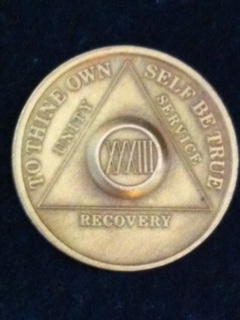
I am not a religious scholar like many of my friends, but I believe it was the Methodists who stressed the importance of having to combine faith with works. For me that is true. I can spend years asking God to solve my problems, but there comes a time when I have to take some personal responsibility and take purposive action before positive outcomes can be achieved. This action shouldn’t be random, it should have a specific purpose. This action should be guided by God.  Using this approach has given me thirty-three years of recovery one day at a time, and I am learning this is how all aspects of my life need to be approached. God bless and keep you.


securedownloadcoin


Photo courtesy of K. Farwell

In my pocket are two things: a quote from  Hafiz saying “I have enough of loss, enough of gain; I have my Love, what more can I obtain?” and a coin celebrating  33 years of recovery that reminds me to be true to myself. Today is supposed to be a day of rest between Jesus’ crucifixion and Christ’s resurrection, and I thought my “soul wrestling” was finally ready to rest for a bit.

Then this morning I was confronted with words I did not want to hear, and my “soul wrestling” started all over again. I listened to well-meaning words that made me face my own character defects and unrealistic expectations of fairness that always get me in trouble.  I was reminded rules are needed to set boundaries and those of us in recovery need rules to help us maintain those boundaries.  I was reminded that suffering is meant to bring me closer to Christ and that every day I have a choice to let suffering do that or to let it come between me and Christ.

The dialogue going on in my head is painful. One voice on the committee keeps saying “I understand the issues underlying rules, but God’s people should be trusted to live ethically without having to abide by ‘rules’—-especially when living ‘by the law’ does more harm than good in my opinion.” Another says, “Christ did not always follow rules either.” The recovering alcoholic two year old inside my head chimes in with his two cents worth and urges me to jump up and down, curse, and just have a plain old “temper tantrum.” A still small voice of reason reminds me to “be true to yourself and don’t let your character defects separate you from God’s love.”  And then Hafiz reminds me, “it is all about God’s love. Period. ”

In re-reading the above paragraph the real problem jumps out at me. There is that single letter “I”—— “I” am the problem. I have to admit my own operational definition of “fair” means “my way.” And when things aren’t my way, I don’ like it,  and I get my feelings hurt.  I have a hard time letting that hurt bring me closer to God. And yet, just this morning, I told a group that “atonement” to me means “At One with God’—————–so why is it so hard for me to accept what I consider to be unfair so that I can be “At One” with God?

So,  this pain is my own fault. I need to accept life on life’s terms just as I need to accept the crucifixion on God’s terms. As long as I am connected with God’s love everything else is just “stuff.” I can choose to “lounge on the pity pot. ” I can choose to do something passive aggressive to enlighten authorities about how “stupid”  their rules are. I can choose to pursue a geographical cure from the site of my spiritual dilemma. I can choose to indulge in one or all of my addictions.

But, most importantly, I can choose to be true to myself and stay connected with God’s love. If I allow my character defects of wanting things to be fair (my way) and resenting authority block the current of love that flows between God and I, then I am the one creating emotional upheaval in my soul. I need to stop trying to “obtain” and just stop and appreciate what I have, the love of God, as all I need. Today I choose to stay connected. May God bless and keep you.


Now we come to the setting of the sun

Image courtesy of Kathryn Farwell

There is something about Holy Week that has always ranged from mildly uncomfortable to extremely unsettling to me——and that is the direct result of wrestling with my own mind and soul. My instinct is to question how any father could allow his son to die such a painful death. Then I realize we–you, me, and others  are the ones that killed him and keep on killing him with our selfish and cruel actions over and over again. That realization is not pleasant either. I find myself wondering “why?” Sure, I know without death there would be no resurrection and without that miracle many would not accept Christ into their hearts. But couldn’t there have been an easier, more humane way of nurturing our faith?  God is patient, God is kind, God is love. God allows his only son to be crucified and to spend six hours in agony while he slowly dies. And, lastly, God allows his son to feel abandoned.

When I peel away my intellectual resistance to this whole Easter thing I realize it is the parts of me that suffered abuse in childhood and abandonment in adulthood that are really angry at God for letting it happen not only to Jesus but also to me. At the core, my strong reactions to anything, sadly enough,  seem to be “all about me.”

The good news is God is patient with me. He sent me some answers yesterday that I am going to try to share in a way that makes sense. First, I attended a presentation by a motivational speaker that I had not known was going to happen until less than an hour before his speech was given. Some of the answers God sent me were in that man’s story. He told us about being in a near-fatal accident when he was a first year college student and about what has happened to him because of that accident. One of the biggest messages he gave was that the most powerful gift you can give another is the gift of presence. He received emergency care that saved his life. He could not talk or see, had to breathe through a tube, was in traction, could barely move, and the only sensory message he was aware of was periodic intense pain. But the memory, the thing, that stood out to him through all those hours of agony was the hand that would intermittently squeeze his and he would squeeze back as a caring voice said, “I’m here.”

The second answer God sent me yesterday was during  a book study session following centering prayer.  One of the topics discussed was that suffering is a gateway to strengthening our spirituality. It is through being broken and wounded that we are connected to God’s presence. His presence is always there, only sometimes it takes something drastic to get our attention. Leonard Cohen’s  song “Anthem” was discussed in regards to the lyric about cracks letting the light in  meaning that it is through being wounded and/or suffering that cracks occur in our perception so the light of God’s spirit can enter into our awareness.

So, you may be asking, where are your answers in all this? Well, I think God was trying to tell me yesterday that yes the crucifixion was painful, yes it is painful to think about it, and, yes it may involve perceived, but short-lived, abandonment—–but you, Kathy, have to seriously consider this event in your soul at least once a year so you can realize God’s love and presence. You need this painful reality to sink in so you can let the light of his spirit to illuminate your soul. He seems to be telling me I should accept the pain of the crucifixion and move away from “why” to “what are am I going to do about this event. God seems to be reminding me that the alternative is to completely miss the gift/miracle inherent in this event by getting bogged down and stuck in my own insecurities, anger, and judgmental questioning.

I have spent an entire career suggesting people stop asking “why” when they contemplate their own addiction and instead, ask , “what can God and I together do about it?”  Yesterday, God directed me to ask that same question to myself in regards to Holy Week. I heard loud and clear yesterday to stop getting stuck in my judgmental head and start asking “What can God and I do together about this?” I  know now that God doesn’t want me to miss this gift and that he wants me to take this love and share it with others instead of questioning the gift. And the next time I want to cry because of Jesus’ pain and perceived abandonment I am going to replace that image with one of God squeezing Jesus’  hand and saying, “I’m here.” God bless and keep you.